
B2B Growth
B2B Strategy: Professional Lookbooks
How to scale wholesale sales with buyer-ready lookbooks that connect creative presentation to pricing, terms, and ordering workflows.


Many brands approach B2B lookbooks like a design project. That is the wrong mental model. A professional lookbook should help a buyer answer practical questions quickly: which SKUs fit my assortment, what margin is available, what is the minimum order, how fast can I replenish, and what visual story will sell through in-store.
The channel context matters. B2B buyers now expect smoother self-serve and sales-assisted experiences across digital touchpoints. If your PDF catalog is weak, your sales team pays for it in repetitive qualification calls.
Why Lookbooks Matter in Modern B2B
A professional lookbook is a sales acceleration asset for three reasons:
- Faster first-pass qualification. Buyers can shortlist ranges before a call.
- Better internal sharing. PDFs and exported links move easily between merchandising, finance, and store ops stakeholders.
- More consistent brand perception. Visual consistency improves trust when accounts compare multiple suppliers.
Shopify positions B2B ecommerce as a core growth path for wholesale brands. Shopify B2B selling guide. This is exactly why structured, buyer-ready assets matter in wholesale sales workflows.
What "Professional" Actually Means
Presentation Quality
- Consistent lighting and angle hierarchy across all SKUs.
- Uniform page rhythm, margins, and product card layout.
- Clear visual separation between product families and use cases.
Buyer Usability
- SKU references and pack variants easy to scan.
- Pricing and minimum order terms unambiguous.
- Order path from lookbook to checkout clearly mapped.
Professional does not mean "over-designed." It means low-friction decision support. If a buyer still needs three emails to understand assortment logic, your lookbook is decorative, not commercial.
Buyer Data Spec for Every SKU Page
Most wholesale lookbooks fail because they are visually polished but operationally thin. Buyers need a complete decision package per SKU, not just an attractive image.
Required fields per SKU spread
- Commercial ID: SKU, variant code, and case pack definition.
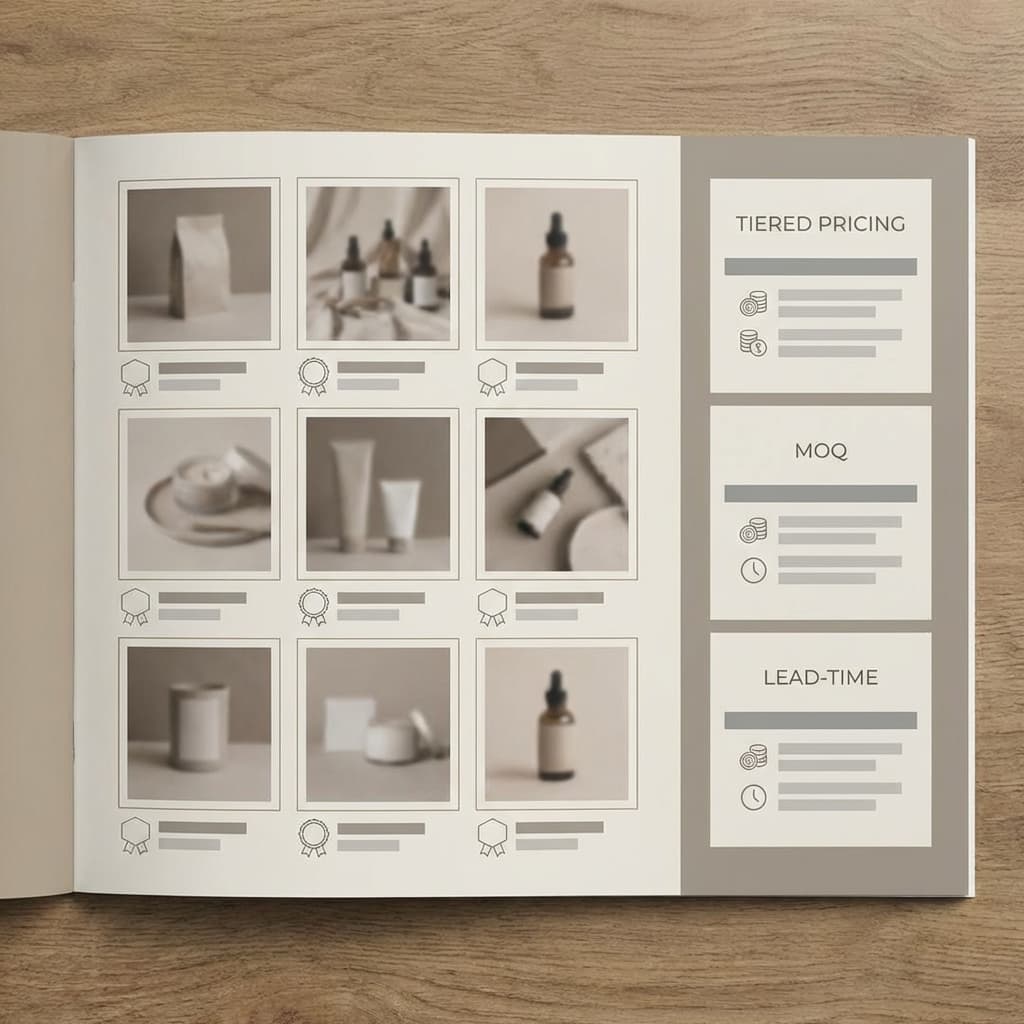
- Order constraints: MOQ, case increments, and replenishment windows.
- Cost structure: wholesale unit price, tier breaks, and suggested retail anchor.
- Logistics profile: dimensions, shipping class, and lead-time range.
- Merchandising intent: primary use case, shelf story, and attachment products.
- Compliance notes: materials, certifications, and claims language limits.
If one of these fields is missing, buyers escalate questions to sales. That slows decision speed and increases quote friction. A professional lookbook minimizes these escalations by design.
Structure That Helps Buyers Decide Fast
Use a fixed structure so every edition is predictable:
- Cover and range thesis: one sentence on the seasonal or category story.
- Assortment overview: product family map with hero visuals and target use case.
- SKU detail spreads: front, context, material close-up, and dimension cues.
- Commercial section: wholesale pricing tiers, MOQs, lead time windows, and reorder rules.
- Operations section: shipping, returns, support process, and contact route.
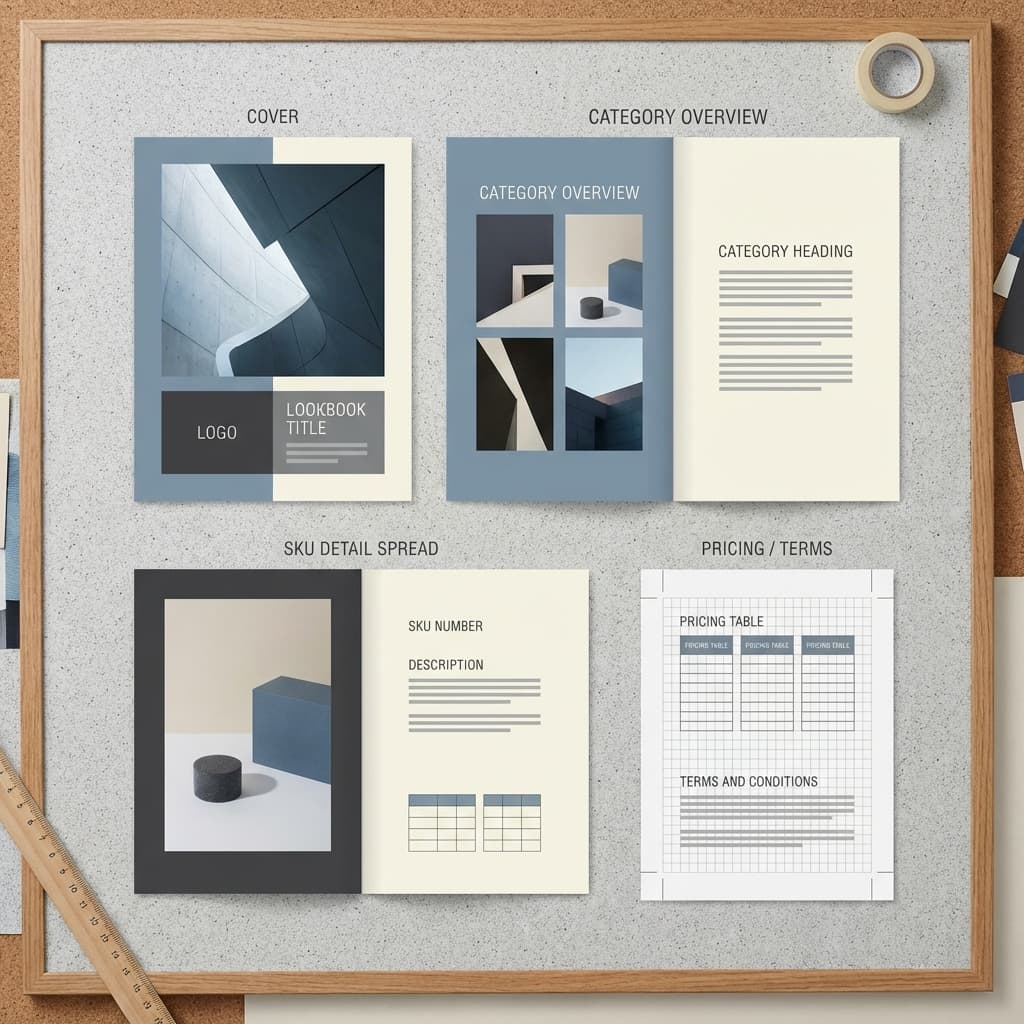
Build one master template and enforce it. This is the same logic behind high performing ecommerce catalog consistency. If your visual system is drifting, use the process from this catalog consistency guide before creating the next wholesale edition.
Pricing and Assortment Architecture
Strong lookbooks do not only show products. They show an assortment logic that protects both sell-through and margin. Buyers want confidence that the range is commercially coherent.
Assortment clarity
- Define core, seasonal, and test lines explicitly.
- Show recommended starter bundle per account size.
- Indicate hero SKUs versus long-tail support SKUs.
Pricing integrity
- Keep tier logic consistent across markets and channels.
- Document trade discount rules and exception paths.
- Align gross margin assumptions with replenishment cadence.
This is where lookbooks and sales operations usually diverge. Treat your pricing pages as controlled outputs from one source of truth, not manual edits in every design file.
Connect Lookbooks to Shopify B2B Operations
The lookbook is the front-end story. Shopify B2B is the transaction engine. If the two are disconnected, sales operations break at scale.
Operational mapping checklist
- Map each lookbook section to a Shopify B2B catalog collection.
- Align price lists and availability logic per market.
- Ensure each buyer company location sees the correct assortment and terms.
- Keep account creation and approvals predictable for wholesale reps.
Shopify documents specific workflows for B2B catalogs, companies, and global market management: Catalogs, Companies, and B2B with Markets.

Video Walkthrough
This embed is a practical reference for teams implementing Shopify B2B structures that your lookbook should map to:
Distribution and Version Control
Most lookbooks degrade after launch, not at launch. Teams send mixed versions, pricing snapshots expire, and old PDFs keep circulating in inboxes.
Prevent that with one distribution policy:
- Use one canonical download URL per season and redirect legacy URLs.
- Stamp visible revision date and version number on each page footer.
- Run an accessibility pass before release. For PDF formats, follow WCAG-related PDF accessibility techniques so documents remain usable in procurement workflows.
Source: W3C accessibility techniques.
Market Localization and Regional Editions
One global PDF is convenient for internal teams but often confusing for buyers. Regional editions reduce friction by matching local expectations and terms.
Localization checklist
- Currency, tax treatment language, and payment term labels by market.
- Unit standards and measurement formats relevant to local buyers.
- Localized fulfillment promises that match regional warehouse capabilities.
- Market-specific hero assortments based on demand and seasonality.
- Translated claim language reviewed for legal and merchandising meaning.
Shopify B2B market tooling helps teams map these regional differences into operational rules rather than static slide edits: Shopify B2B with Markets.
Measurement and Governance Model
A lookbook should be measured like a revenue asset. Without instrumentation, teams rely on anecdotal sales feedback and cannot improve the next edition with confidence.
Core KPI stack
- Distribution metrics: open rate, first-view time, and regional adoption.
- Engagement metrics: top viewed category pages, repeat views, and rep-forward rate.
- Pipeline metrics: quote requests, sample requests, and buyer qualification speed.
- Commercial metrics: average order value, reorder velocity, and gross margin mix.
- Quality metrics: version compliance, data error rate, and asset correction cycle time.
Assign one owner for each release: version lead, data lead, design lead, and sales enablement lead. This ownership model prevents drift between beautiful visuals and actual wholesale execution.
How Rendery3D Accelerates Lookbook Production
Professional lookbooks fail when visual production is inconsistent. One SKU is over-lit, another is low resolution, a third has mismatched perspective. That visual noise makes even strong products look risky to wholesale buyers.
With Rendery3D, teams can generate consistent product imagery in a controlled style system, then publish those assets into their lookbook template and B2B storefront. Start from AI product photography, extend with background variants, and route buyers to your live wholesale flow through a unified account path.
Production benchmark for lean B2B teams
- 50 to 150 SKU lookbook refresh in one production sprint.
- One locked visual template for all categories and markets.
- Versioned exports for reps, buyers, and regional partners.
Launch Checklist
- Lookbook structure follows a consistent buyer decision flow.
- Each SKU spread maps to the right B2B catalog and price list.
- Version number, revision date, and accessibility checks are complete.
- Sales reps use one canonical URL and one active edition only.
If you are ready to scale from ad hoc PDFs to a repeatable wholesale asset system, start by standardizing your top category in Rendery3D and ship one controlled seasonal edition first.
Final Strategy Note
Treat your lookbook like a product, not a file. Give it an owner, release cycles, QA criteria, and performance metrics. The teams that win wholesale expansion are the teams that operationalize this asset.